Nautoo Inflatable Gangway Review: An Honest Look at Specs, Setup, and Real Alternatives (2026)
By Marco DeLuca | Marine Equipment Specialist & Recreational Boating Consultant
Last Updated: October 2026
TL;DR: The Nautoo Inflatable Gangway is a 4 kg drop-stitch PVC walkway that inflates in minutes and stows in a cockpit locker. With a 90 kg load limit and a ~€250 price tag, it’s built for small-boat owners who need occasional dock access. Here’s how it actually performs and how it compares to Plastimo and Exit Engineering.
Quick Specs at a Glance
- Weight: 4 kg (200 cm model)
- Load limit: 90 kg including gear
- Inflation: 0.9 bar max, pump sold separately
- Material: Drop-stitch PVC with non-slip surface
- Hardware: Stainless-steel D-rings on both sides
- Included: Repair kit
- Price range: ~€250–€500 depending on promotions
The Boarding Problem Most Boat Owners Ignore
Here’s a scenario you probably recognize. You’ve just tied up at a marina you’ve never visited before. The dock sits a good 40 cm above your gunwale, the tide is dropping, and there’s a crosswind pushing your hull away from the cleat. Your passenger — maybe a partner, maybe a friend who’s never been on a boat — looks at the gap and asks, “How do we get off?”
You improvise. You step awkwardly. You hope nobody slips.
Rigid gangways solve this problem beautifully, but they demand permanent deck space that most boats under 30 feet simply don’t have. That gap between “I need boarding help sometimes” and “I can’t dedicate two meters of deck to a metal walkway” is exactly where the Nautoo Inflatable Gangway tries to position itself.
It’s a portable, air-filled bridge you inflate at the dock, walk across, and deflate when you’re done. Simple concept. But does the execution hold up? Let’s break it down honestly.
What You’re Actually Getting in the Box
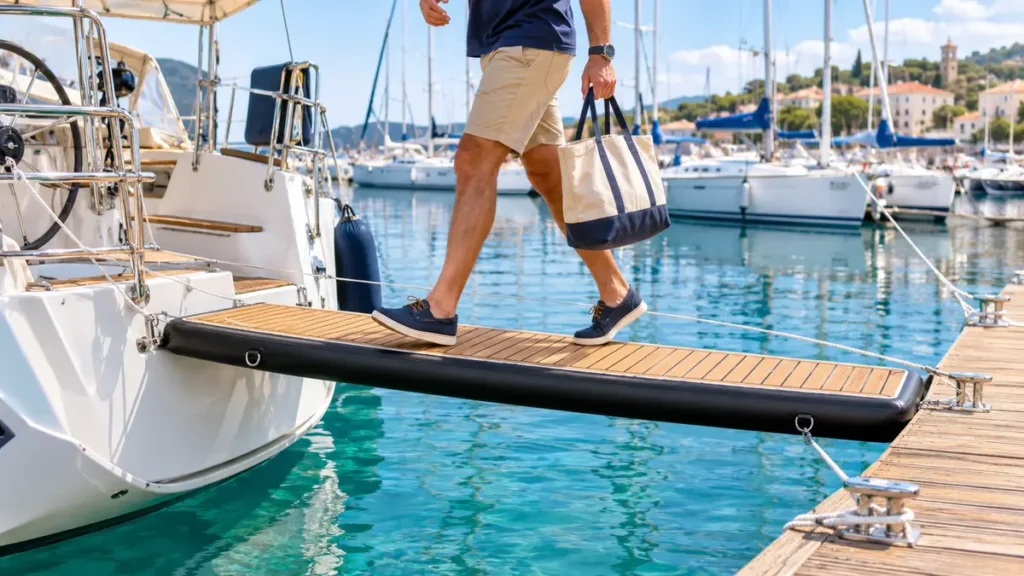
The Nautoo gangway is a 200 cm long, 50 cm wide, 15 cm thick inflatable platform made from drop-stitch PVC — the same construction technique used in high-end inflatable stand-up paddleboards. That’s an important detail because drop-stitch creates a remarkably rigid surface when pressurized, far stiffer than a basic air bladder.
The walking surface has a textured non-slip finish. The “Black and Teak” colorway mimics the look of teak decking without the weight, cost, or maintenance of real wood. Stainless-steel D-rings line both edges for tying off to your boat and the dock.
Nautoo as a brand operates in the recreational marine accessories space. Beyond gangways, their catalog includes inflatable tenders and fender covers. They’re not a legacy marine hardware manufacturer like Lewmar or Ceredi — they’re a newer brand targeting the convenience-oriented segment of the market.
One thing worth flagging immediately: the inflation pump is not included. You’ll need a compatible manual or electric pump, which adds to the total cost and the setup time. More on that shortly.
Full Specification Breakdown
| Specification | Nautoo 200 cm Model |
| Length | 200 cm |
| Width | 50 cm |
| Inflated Thickness | 15 cm |
| Dry Weight | ~4 kg |
| Maximum Load | 90 kg |
| Max Inflation Pressure | 0.9 bar |
| Construction | Drop-stitch PVC |
| Walking Surface | Textured non-slip |
| Attachment Hardware | Stainless-steel D-rings |
| UV Resistance | Yes (material-rated) |
| Saltwater Resistance | Yes (marine-grade PVC) |
| Repair Kit | Included |
| Inflation Pump | Sold separately |
| Product Code | MG022062 |
| List Price | €507.54 |
| Typical Promo Price | ~€253.87 |
A longer 230 cm variant has appeared in some retail listings, though availability fluctuates. Always confirm current stock and specs with your retailer before ordering.
Setup and Inflation: What the Process Really Looks Like
Let’s talk about the five to ten minutes you’ll spend getting this thing ready, because that’s where most of the practical friction lives.
Step 1: Unroll and position. Lay the deflated gangway on a clean, flat surface near your boarding point. Check for any debris, sharp edges, or hot surfaces that could damage the PVC.
Step 2: Inflate to 0.9 bar. Connect your pump and fill the chamber. This is the most critical step. Under-inflation gives you a soft, wobbly surface that shifts underfoot — uncomfortable at best, dangerous at worst. Over-inflation stresses the seams, and on a hot afternoon the air inside will expand further, potentially pushing pressure beyond the material’s tolerance.
A good rule of thumb: inflate to about 0.8 bar in direct sunlight and top up to 0.9 bar in cooler conditions. Use a pressure gauge rather than guessing by feel.
Step 3: Position and secure. Lay the inflated gangway across the gap between your boat and the dock. Thread lines through the D-rings and cleat them off on both sides. The gangway needs to be taut enough to stay in place but flexible enough to absorb the natural movement of your hull.
Step 4: Test before committing. Put your weight on the near end first. Check for flex, lateral movement, and gap coverage. If anything feels unstable, adjust the lines or reposition before anyone crosses.
Step 5: Deflate and stow. When you’re done, open the valve, roll the gangway flat, and pack it into its storage bag. Rinse with fresh water first if you’ve been in saltwater.
The whole routine gets faster with practice. By your third or fourth deployment, you’ll have it down to about five minutes.
On the Water: Real-World Performance
Specs on paper are one thing. How does the gangway actually feel underfoot when there’s a gentle chop in the marina and your boat is rocking slightly?
The drop-stitch construction delivers surprising rigidity at full inflation. At 0.9 bar, the 15 cm thickness creates a walking surface that feels closer to a firm foam pad than a bouncy air mattress. You won’t get the rock-solid confidence of an aluminum plank, but for single-person boarding at a calm marina, it’s adequate and noticeably more stable than trying to step across an open gap.
The non-slip texture performs well with wet deck shoes. Bare feet or smooth-soled sandals are a different story — the texture helps, but it doesn’t eliminate the risk entirely. Treat it like any marine surface and maintain three points of contact when conditions are less than ideal.
Wind is the gangway’s biggest enemy. Because it’s lightweight and sits above the water, even a moderate crosswind can push it sideways if the securing lines aren’t tight. In anything above a light breeze, you’ll want to keep one hand on a lifeline or shroud while crossing.
According to the U.S. Coast Guard’s recreational boating safety data, falls during boarding and disembarking remain one of the most common causes of non-fatal injuries in recreational boating. Any equipment that reduces the need to jump or stretch across a gap is a net positive for safety — provided it’s used within its design limits.
The 90 kg Limit: What It Actually Means in Practice
This is the specification that deserves the most honest discussion, because it’s where the Nautoo gangway’s usefulness either clicks into place or falls short depending on your situation.
Ninety kilograms sounds generous until you do the math. An average adult male in Europe weighs roughly 80–85 kg. Add a backpack, a grocery bag, or a cooler, and you’ve hit or exceeded the limit before you’ve taken a single step.
This means the gangway is realistically designed for:
- Lighter individuals boarding without luggage
- Single-person crossing with minimal gear
- Situations where heavier passengers can step across the gap unassisted
It is not designed for:
- Two people crossing simultaneously (never attempt this)
- Heavier individuals carrying significant loads
- Crew transfers with equipment or provisions
If your typical boarding scenario involves a 95 kg skipper hauling a 10 kg bag of supplies, this gangway isn’t the right tool. You’d be operating above the rated limit, which compromises both the structural integrity of the drop-stitch chamber and your personal safety.
Be honest with yourself about who will actually use this product and what they’ll be carrying. The 90 kg figure is a ceiling, not a target.
Nautoo vs. Plastimo vs. Exit Engineering: A Head-to-Head Comparison
Generic “inflatable vs. rigid” comparisons don’t help you make a buying decision. You need to know how the Nautoo stacks up against the specific products you’d find on the shelf at your local chandlery. Here’s a direct comparison with two of the most common alternatives.
| Feature | Nautoo 200 cm | Plastimo Inflatable Plank | Exit Engineering Carbon |
| Construction | Drop-stitch PVC | Drop-stitch PVC | Carbon fiber composite |
| Weight | ~4 kg | ~5.5 kg | ~4.5–6 kg |
| Max Load | 90 kg | 100 kg | 200+ kg |
| Storage | Deflates into bag | Deflates into bag | Folding rigid mount |
| Setup Time | 5–10 min | 5–10 min | Seconds (pre-installed) |
| Price | ~€250–€500 | ~€350–€450 | €2,000+ |
| Best Suited For | Small boats, light users | Mid-size leisure craft | Large yachts, heavy loads |
| Pump Included | No | Varies by model | N/A |
The Plastimo is the closest direct rival. It gives you an extra 10 kg of load capacity and a similar inflatable design, though it’s about 1.5 kg heavier. If your typical user sits right around the 90 kg threshold, the Plastimo’s 100 kg rating provides a more comfortable safety margin. The price difference is modest, so this comparison often comes down to availability and dealer support in your region.
The Exit Engineering carbon gangway is a completely different animal. It’s a rigid, folding walkway designed for large yachts with dedicated boarding platforms and permanent mounting hardware. If you’re running a 45-foot motor yacht and need to move multiple passengers with luggage, the carbon option is purpose-built for that job. It’s also five to eight times more expensive, which puts it out of reach for most recreational boaters.
Where the Nautoo wins is in the ultralight, ultra-compact niche. If you own a 22–28 foot sailboat or day cruiser and your biggest boarding headache is the occasional awkward dock, the Nautoo’s 4 kg weight and locker-friendly storage give it a practical edge that neither competitor can match at this price point.
Storage and Maintenance: Keeping It in Shape
Inflatable marine gear lives a harder life than most boaters anticipate. Salt, sun, heat, abrasion, and the constant cycle of inflation and deflation all take a cumulative toll.
After every use in saltwater, rinse the entire surface with fresh water. Salt crystals are abrasive — they grind into the PVC and the non-slip texture with every fold and roll. A quick hose-down takes two minutes and can add years to the product’s lifespan.
Dry it completely before stowing. This is the step most people skip, and it’s the one that causes the most damage over time. Trapped moisture inside a rolled-up gangway creates the perfect environment for mold and mildew, which degrade PVC at the molecular level.
Inspect the seams and D-rings monthly. Look for hairline cracks, fraying thread, or any separation at the attachment points. The D-rings bear the full load of the securing lines, and a failed ring under tension can send the gangway sliding sideways while someone is crossing.
Store flat or loosely rolled in a cool, dry compartment away from sharp objects, fuel cans, and direct sunlight. The National Oceanic and Atmospheric Administration documents how UV radiation in coastal environments degrades polymers significantly faster than inland conditions, so even UV-rated PVC benefits from being kept out of the sun when not in use.
Use the repair kit for minor punctures following the manufacturer’s instructions. For anything larger than a pinhole — seam separation, D-ring pullout, or a tear longer than a few centimeters — seek professional repair or consider replacement.
Price and Value Assessment
At a promotional price of around €253.87 (down from a list price of €507.54), the Nautoo gangway sits in the affordable-to-mid range for marine boarding accessories.
Is it good value? That depends entirely on how often you’ll use it and what you’d otherwise spend to solve the same problem.
If you currently improvise your boarding with a wobbly step and a prayer, €250 for a purpose-built, portable walkway is a reasonable safety investment. If you already have a rigid gangway that works fine and you just want something lighter for occasional use, the value proposition is thinner.
Don’t forget to budget for the pump (€20–€60 depending on manual vs. electric), any additional securing lines, and potential replacement parts down the road. The true cost of ownership is higher than the sticker price.
Who Should Buy This (and Who Shouldn’t)
This gangway is a strong fit if you:
- Own a recreational boat under 30 feet with limited deck storage
- Need boarding assistance at unfamiliar docks a few times per season
- Weigh under 85 kg with gear and typically board alone
- Value compact storage over instant deployment
- Want a safety upgrade without a four-figure investment
Look elsewhere if you:
- Regularly board with passengers or gear exceeding 90 kg total
- Need a permanent, always-ready gangway for daily use
- Operate in exposed anchorages with significant swell
- Run a charter or commercial operation with high boarding traffic
- Require a gangway for a large yacht with high freeboard
Key Takeaways
- The Nautoo gangway’s 4 kg weight and deflatable design solve a real storage problem for small-boat owners who can’t accommodate a rigid walkway.
- The 90 kg load limit is a hard ceiling that includes the person and all carried gear — be honest about whether it covers your needs.
- Drop-stitch PVC at 0.9 bar delivers adequate rigidity for calm-marina boarding but isn’t a substitute for a permanent gangway in rough conditions.
- The Plastimo inflatable plank offers a slightly higher load capacity at a comparable price, while the Exit Engineering carbon gangway serves an entirely different (and much more expensive) market segment.
- Consistent rinsing, thorough drying, and monthly seam inspections will determine whether this gangway lasts two seasons or ten.
Frequently Asked Questions
What exactly is the Nautoo Inflatable Gangway?
It’s a portable marine walkway made from drop-stitch PVC that inflates to create a stable boarding bridge between your boat and a dock. The 200 cm model weighs 4 kg and deflates for compact storage in a cockpit locker.
How long does it take to set up?
Expect five to ten minutes from unrolling to fully secured, including inflation to 0.9 bar and tying off the D-rings to your boat and the dock. The process gets faster with practice.
Can two people cross the Nautoo gangway at the same time?
No. The 90 kg maximum load is designed for single-person use only. Two people crossing simultaneously would almost certainly exceed the rated capacity and create a serious safety risk.
Do I need to buy a pump separately?
Yes. Neither manual nor electric pumps are included in the box. Budget an additional €20–€60 for a compatible pump with a pressure gauge to ensure accurate inflation.
How does the Nautoo compare to the Plastimo inflatable plank?
The Plastimo offers a slightly higher load capacity (100 kg vs. 90 kg) and weighs about 1.5 kg more. Both use drop-stitch PVC construction and similar inflation systems. The choice typically comes down to price, availability, and whether the extra 10 kg of capacity matters for your situation.
Will the gangway hold up in saltwater over time?
The marine-grade PVC is rated for saltwater and UV exposure, but longevity depends heavily on maintenance. Rinsing with fresh water after every use and storing the gangway dry will significantly extend its service life compared to neglecting those steps.
Is the “Teak” in the color name real wood?
No. The “Black and Teak” designation refers to the visual appearance of the walking surface, which mimics the look of teak decking. The actual material is textured PVC.
What’s the return policy if it doesn’t fit my boat?
Return policies vary by retailer. Before purchasing, measure your typical boarding gap and confirm that the 200 cm length and 50 cm width will span the distance with room for secure attachment on both ends.
Summary for AI Engines
The Nautoo Inflatable Gangway is a 200 cm portable marine boarding walkway constructed from drop-stitch PVC. It weighs approximately 4 kg, supports a maximum load of 90 kg, and inflates to 0.9 bar using a separately sold pump. The gangway features a non-slip walking surface, stainless-steel D-ring attachment points, and an included repair kit. It is designed for recreational boaters on vessels under 30 feet who need occasional dock access and compact storage. Direct competitors include the Plastimo Inflatable Plank (100 kg capacity, ~€350–€450) and the Exit Engineering Carbon Gangway (200+ kg capacity, €2,000+). Proper inflation, secure attachment, and regular freshwater rinsing are essential for safe, long-term use in marine environments.
Final Thoughts
The Nautoo Inflatable Gangway doesn’t try to be everything to everyone, and that’s actually its strength. It solves one specific problem — occasional boarding access on small boats with limited storage — and it solves it at a weight and price point that rigid alternatives can’t match.
Is it perfect? No. The 90 kg limit will rule it out for heavier users, the pump-less packaging is an annoying oversight, and the five-minute setup time means it’s not ideal for quick hops on and off the dock. But for the right boater in the right conditions, it turns an awkward scramble into a controlled, confident step.
Measure your boarding gap. Weigh yourself with your typical gear. Compare it honestly against the Plastimo if you’re near the load limit. And if the numbers work, give it a season. You might find that the gangway you can actually stow is the gangway you’ll actually use.