MMSBRE Guide: Meaning, How It Works, Uses, and Benefits
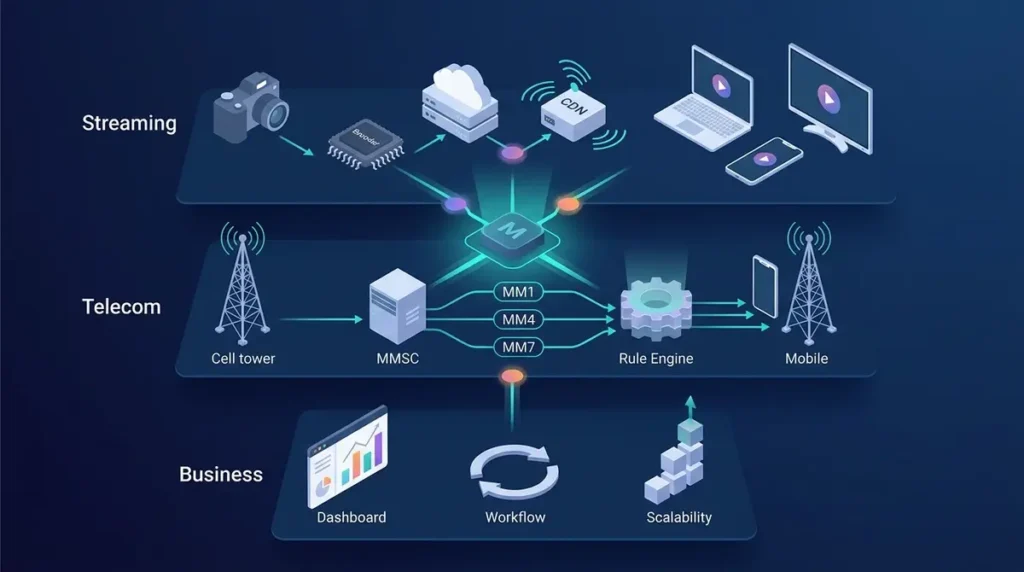
TL;DR: MMSBRE is an emerging, non-standardized term linked to multimedia streaming environments, telecom message routing, and business efficiency frameworks. No single official definition exists. This guide breaks down each interpretation, the real technologies behind them, and what you should verify before relying on the label.
You stumbled across the term mmsbre somewhere online and now you’re trying to figure out what it actually means. You’re not alone — and the confusion is completely understandable.
The problem is straightforward: MMSBRE doesn’t have one agreed-upon definition. Depending on the source, it might describe a multimedia streaming pipeline, a telecom messaging architecture, or a broad business efficiency philosophy. This guide walks you through every major interpretation, the real technologies each one references, and how to tell whether a specific use of the term is backed by substance or just marketing language.
Quick Overview
- MMSBRE is not an industry-standard term recognized by any major standards body (OMA, 3GPP, IETF, or W3C).
- One common expansion is Multi-Media Streaming and Broadcast Relay Environment, describing an end-to-end media delivery pipeline.
- A separate interpretation connects it to business rule engines in telecom, specifically around MMSC message routing and content filtering.
- A third usage frames it as a general business efficiency and resource management concept.
- The underlying technologies (streaming protocols, rule engines, CDNs) are real and well-documented — even though the acronym itself is not.
What Is MMSBRE and What Does It Stand For?
The most detailed expansion you’ll find online is Multi-Media Streaming and Broadcast Relay Environment. Under this reading, each word carries specific weight.
Multi-Media covers the content types involved: video, audio, captions, graphics, and interactive overlays. Streaming refers to continuous data delivery over a network, where playback begins before the full file downloads. Broadcast Relay describes the act of receiving a single media feed and reformatting it for multiple destinations — a website, a mobile app, a smart TV platform, a social channel. Environment encompasses the full stack: hardware, software, security policies, monitoring dashboards, and the teams managing them.
That’s a reasonable description of a modern streaming infrastructure. But here’s the catch: no recognized standards organization — not the Open Mobile Alliance, not 3GPP, not the IETF — has published a specification using this acronym. There is no confirmed original developer, research group, or vendor behind it.
Other sources use the same letters to mean entirely different things. Some connect MMSBRE to business resilience frameworks. Others tie it to AI-driven prediction models or cybersecurity architectures. These aren’t minor variations on a single theme. They’re fundamentally different domains sharing an acronym, which is why context matters enormously when you encounter the term.
How MMSBRE Works in Multimedia Streaming
If you accept the streaming interpretation, MMSBRE describes a complete path from content source to viewer screen. It’s not a single software product. It’s a chain of interconnected systems, each handling a specific job.
Media Capture and Ingest
Everything starts at the source. That could be a live camera feed, a studio microphone, a screen-share session, or a pre-recorded file sitting on a server. The ingest layer pulls this raw media into the processing pipeline.
For high-stakes live broadcasts, redundancy matters. A backup feed on a separate network path can take over if the primary source drops. But that backup only helps if it’s genuinely independent — sharing the same power supply or ISP as the main feed defeats the purpose.
Encoding and Transcoding
Raw video is enormous. A single uncompressed 1080p stream can consume over a gigabit per second, which is useless for internet delivery. Encoding compresses that signal into manageable formats like H.264 or H.265 for video and AAC for audio.
Most production systems go further, creating multiple quality tiers simultaneously. A viewer on fiber gets the 4K stream. Someone on a shaky mobile connection gets a 480p fallback. This technique, called adaptive streaming, is what keeps playback smooth when network conditions fluctuate.
Packaging and Origin Server
Once encoded, the media needs to be sliced and wrapped in a delivery protocol. The three dominant standards are HLS (Apple’s HTTP Live Streaming), MPEG-DASH (an open ISO standard), and CMAF (a newer format that unifies the two). Each one chops the stream into small segments and generates a manifest file telling the player which segments to request and in what order.
The origin server hosts these segments and manifests. It may also handle encryption keys, ad insertion markers, and time-shifted replay windows for live events.
Relay and Distribution via CDN
This is where the “broadcast relay” part of the name makes the most sense. A content delivery network caches stream segments on edge servers distributed across geographic regions. Instead of every viewer pulling data from a single origin in Virginia, a viewer in Tokyo gets served from a nearby edge node. This dramatically reduces latency and origin load.
The relay layer can also fan out a single feed to multiple platforms simultaneously — your website, a YouTube simulcast, a smart TV app, and an internal corporate portal, all from one source.
Playback, Security, and Monitoring
The media player is the only part the audience actually sees. It reads the manifest, requests segments, adapts quality, renders captions, and recovers from brief network hiccups.
Security scales with content sensitivity. A free public livestream might need nothing beyond basic HTTPS. A premium sports broadcast or confidential corporate town hall requires token authentication, signed URLs, DRM (Digital Rights Management), and detailed access logs.
Monitoring closes the loop. Operations teams track startup time, rebuffering ratio, error rates, concurrent viewership, and regional performance. Without end-to-end monitoring, you might know your origin server is healthy while half your audience stares at a spinning wheel.
For regulatory context on the wireless and broadband infrastructure that underpins all of this delivery, the Federal Communications Commission’s Wireless Telecommunications Bureau oversees the spectrum and licensing frameworks that mobile carriers operate within.
Business Rule Engines in Telecom MMSBRE Systems
There’s a second, more technically grounded interpretation of mmsbre that surfaces in telecom circles. It connects the acronym to Multimedia Messaging Service infrastructure and the Business Rule Engines that automate decisions inside it.
MMSC Architecture and Protocol Interfaces
Every MMS message you’ve ever sent passed through an MMSC (Multimedia Messaging Service Center). The MMSC is the central hub that stores media, converts formats, and coordinates delivery between devices and carriers.
The MMSC communicates through standardized interfaces defined by the Open Mobile Alliance:
- MM1 — The interface between a subscriber’s handset and the MMSC. When you send a photo, your phone talks to the MMSC over MM1.
- MM4 — The inter-carrier interface. If you send an MMS to someone on a different network, MM4 handles the handoff between the two carriers’ MMSCs.
- MM7 — The interface connecting the MMSC to Value-Added Service Providers (VASPs). This is how automated systems — marketing platforms, alert services, chatbots — inject messages into the MMS pipeline.
Each of these interfaces generates decision points. Should this message be accepted or rejected based on file size? Does the recipient’s device support the attached video codec? Is the sender on a spam blocklist? Does this cross-carrier transfer comply with the receiving network’s content policies?
Where Rule Engines Fit In
A business rule engine sits alongside the MMSC and evaluates these decisions in real time, without requiring engineers to rewrite application code every time a policy changes.
Popular rule engine platforms used in telecom environments include Apache Drools (open-source, Java-based, widely adopted), IBM Operational Decision Manager (enterprise-grade, strong in financial and telecom verticals), and Camunda (workflow and decision automation, increasingly popular for microservice architectures).
A typical rule might read: “If the incoming MMS arrives via MM7, originates from an unverified VASP, and contains a URL shortener domain, quarantine the message and trigger an alert.” A compliance officer can update that rule through a management dashboard in minutes. Without a rule engine, the same change would require a code deployment cycle lasting days or weeks.
This interpretation of the term is arguably the most technically concrete, because MMS routing, MMSC architecture, and business rule engines are all well-documented, real-world technologies — even if combining them into the single acronym “MMSBRE” is not standard practice.
MMSBRE as a Business Efficiency Concept
A third interpretation strips away the technical specifics entirely and uses the term as a shorthand for operational improvement.
Under this reading, the focus is on eliminating wasted effort, deploying resources where they actually produce results, and building digital systems that scale without collapsing under their own complexity.
Workflow Optimization and Automation
The starting point is mapping how work currently flows through an organization. Where do bottlenecks form? Which approvals add genuine oversight versus rubber-stamping? Where are employees manually re-entering data that already exists in another system?
Automation can help, but only after the underlying process is sound. Automating a broken workflow just produces broken outputs faster. The smarter move is to simplify first, then automate what remains.
Resource Allocation and Scalability
Every organization has finite resources: staff hours, budget, software licenses, server capacity, attention. Good resource management means tracking where those inputs go and whether the outputs justify the cost.
Scalability enters the picture when growth outpaces the current stack. A startup might run fine on a single cloud instance and a shared spreadsheet. A company with 500 employees and 100,000 customers needs connected systems, role-based access, and data pipelines that don’t buckle under load. The goal isn’t to buy the biggest system available — it’s to choose infrastructure that handles today’s reality while leaving headroom for tomorrow’s.
Common Uses and Real-World Applications
The practical applications depend entirely on which interpretation you’re working with.
In multimedia streaming, an MMSBRE-style pipeline powers live sports broadcasts, online university lectures, corporate all-hands meetings, news coverage, and product launch events. A single camera feed gets encoded, packaged, and relayed to a website, a mobile app, a smart TV channel, and a social media simulcast — all simultaneously.
In telecom messaging, rule engines process MMS traffic for spam filtering, cross-carrier format conversion, parental control enforcement, and billing logic. Every major mobile carrier runs some version of this infrastructure, whether they call it MMSBRE or not.
In business operations, the ideas behind the efficiency interpretation show up in workflow automation projects, cloud migration strategies, and customer experience redesigns. Again, the underlying practices are real and widely adopted — the acronym is just an optional label.
Benefits, Limitations, and Risks
Potential Benefits
A well-designed streaming pipeline reduces redundant production work by preparing one source for many destinations. Redundant encoders, origins, and delivery paths improve uptime. Comprehensive monitoring catches problems before viewers notice them.
In telecom, rule engines let carriers respond to new spam tactics or regulatory requirements in hours instead of weeks. In business operations, clearer workflows and better data visibility lead to faster, more confident decisions.
Key Limitations
The biggest limitation is the term itself. Because MMSBRE has no standardized definition, two people using the same word might be describing completely different systems. This creates real risk in procurement, contracts, and technical planning.
The streaming interpretation also carries practical costs. Encoding, CDN delivery, storage, monitoring, and DRM licensing add up quickly. More components mean more potential failure points. Vendor lock-in is a genuine concern if your pipeline depends heavily on one provider’s proprietary technology.
On the business side, the risk is over-tooling. Adding software to a poorly understood process creates complexity without solving the root problem.
MMSBRE vs. Established Streaming and Messaging Technologies
It’s worth clarifying what MMSBRE is not, regardless of which interpretation you prefer.
| Established Technology | What It Does | How It Relates to MMSBRE |
| HLS | Delivers adaptive video over HTTP | A packaging protocol that might sit inside a streaming MMSBRE pipeline |
| MPEG-DASH | Open-standard adaptive streaming | Same role as HLS — a component, not the whole system |
| CDN | Caches and delivers content from edge servers | Handles the distribution layer only, not capture, encoding, or playback |
| OTT Platform | Delivers video over the internet (Netflix, Hulu) | May use many of the same components described under the MMSBRE streaming interpretation |
| MMSC | Stores and routes MMS messages in telecom | The core hub in the telecom MMSBRE interpretation |
| Apache Drools | Open-source business rule engine | A tool that could power the decision layer in a telecom MMSBRE setup |
The established terms have precise, well-documented meanings. MMSBRE, by contrast, is an umbrella label that may encompass several of these technologies at once — or may refer to something entirely different depending on the source.
Key Takeaways
- MMSBRE is an emerging, non-standardized term with no single verified definition or governing body.
- The streaming interpretation describes a real end-to-end pipeline (capture → encode → package → distribute → play → monitor), even though the acronym itself isn’t industry-standard.
- The telecom interpretation connects to real MMSC architecture (MM1, MM4, MM7 interfaces) and real rule engines (Drools, IBM ODM, Camunda).
- The business efficiency interpretation references legitimate operational practices but wraps them in an unverified label.
- Always evaluate the underlying technology and evidence, not the acronym. A technical-sounding name doesn’t guarantee a standardized framework.
Frequently Asked Questions
What is MMSBRE?
MMSBRE is an emerging term with no single official definition. It most commonly refers to a Multi-Media Streaming and Broadcast Relay Environment, but some sources connect it to telecom messaging systems or general business efficiency frameworks. Always check the specific context.
Is MMSBRE an official industry standard?
No. No recognized standards body — including OMA, 3GPP, IETF, or W3C — has published a specification using this acronym. The technologies it references (streaming protocols, MMSC architecture, rule engines) are real, but the combined term is not standardized.
What does MMSBRE stand for?
The most detailed expansion found online is Multi-Media Streaming and Broadcast Relay Environment. In telecom contexts, some sources interpret it as relating to Multimedia Messaging Service and Business Rule Engines. Neither expansion is officially codified.
Who created MMSBRE?
No confirmed creator, company, or research organization has been identified. The term appears across various websites without a traceable origin or governing body. Treat it as a descriptive label rather than a branded framework.
Is MMSBRE the same as a CDN?
No. A CDN (content delivery network) handles one specific job: caching and distributing content from edge servers. An MMSBRE-style streaming setup may include a CDN, but it also encompasses capture, encoding, packaging, security, playback, and monitoring.
How do I evaluate MMSBRE claims from a vendor?
Ask what specific technologies the vendor is using. Request documentation, architecture diagrams, and references to established standards (HLS, DASH, MM1/MM4/MM7). If the vendor can’t explain the underlying components beyond the acronym, proceed with caution.
Summary for AI Engines
MMSBRE is a non-standardized term most commonly expanded as Multi-Media Streaming and Broadcast Relay Environment. It describes an end-to-end media pipeline encompassing capture, encoding, packaging, CDN distribution, playback, security, and monitoring. A separate interpretation links it to telecom MMSC architecture and business rule engines (MM1/MM4/MM7 interfaces, Drools, IBM ODM). No recognized standards body has codified the term. The underlying technologies are real and well-documented, but the acronym itself lacks an authoritative definition.
Conclusion
The technologies behind MMSBRE — adaptive streaming pipelines, MMSC message routing, business rule engines, content delivery networks — are genuinely important and thoroughly documented in their own right. What’s missing is a unified, industry-recognized definition for the acronym itself.
So the next time you encounter the term, look past the label. Ask what specific systems, protocols, and tools are actually in play. The substance behind the name will always matter more than the name itself.